
Electrochemical energy storage system integration project
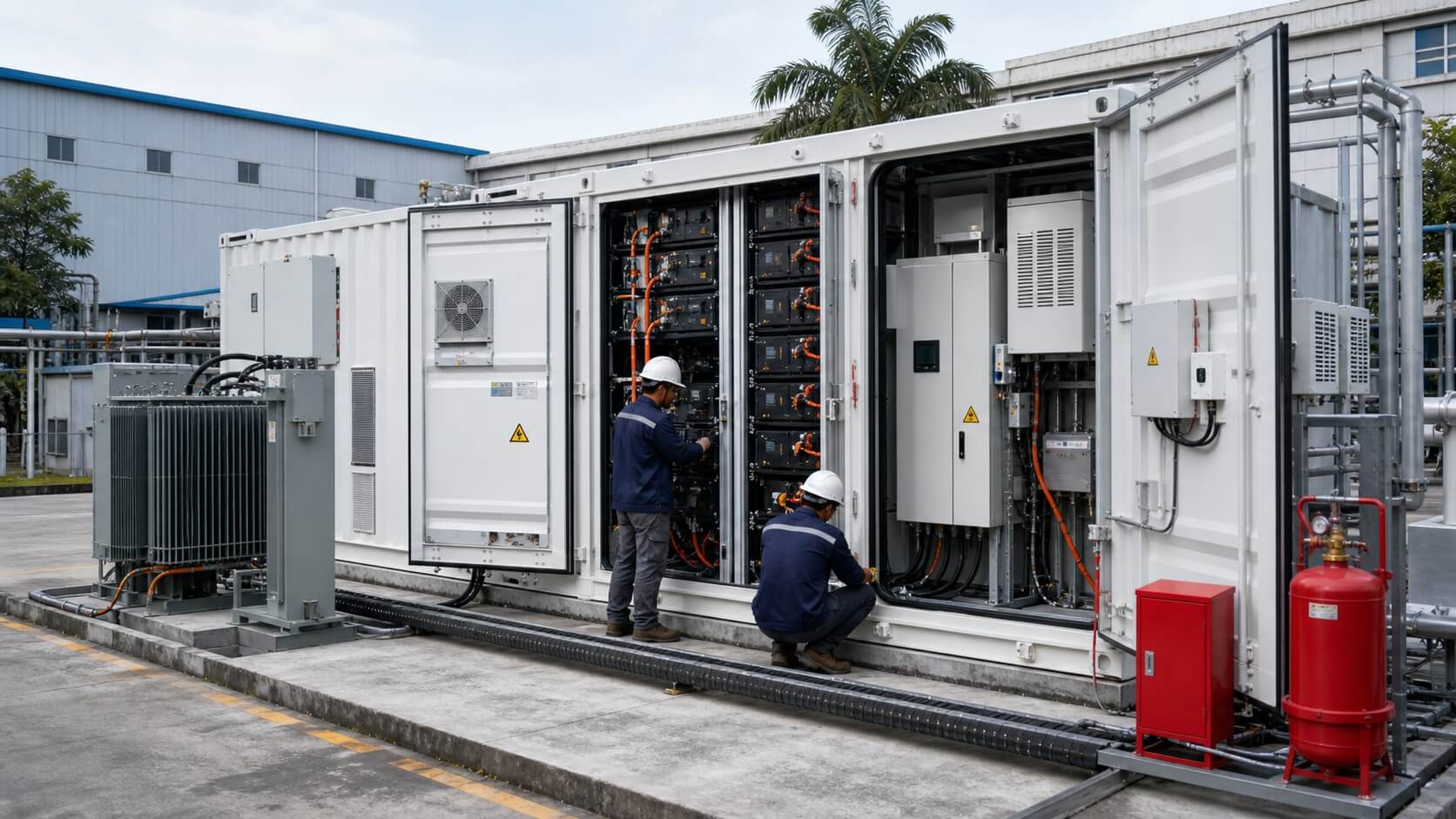
Project overview
Provide standardized energy storage system integration services for the park, including battery cells, battery clusters, PCS converters, EMS energy management systems and container integration to achieve the dual functions of peak and valley arbitrage and backup power supply.
Indonesia fit
Battery cells, PCS, EMS, fire protection, grid connection and revenue models are packaged and delivered for industrial and commercial parks to solve the problem of unclear system efficiency, certification and after-sales responsibilities after purchasing batteries or PCS separately. EMS can remotely adjust the strategy according to Indonesian peak and valley electricity prices, backup power demand and photovoltaic output, adapting to policy changes and park load fluctuations.
Professional configuration and standards
The system uses LFP batteries, liquid cooling thermal management, PCS bidirectional conversion, EMS energy management and container fire protection, refer to IEC 62619, IEC 62933, IEC 62477, IEC 60529, IEC 61643 and SNI/PLN grid connection requirements; capacity, insulation withstand voltage, BMS balance, PCS efficiency, fire linkage, thermal management, grid connection protection and 72 hours dry run test.
Key specification comparison table
| Configuration items | common practice | Optimized delivery specifications and value |
|---|---|---|
| Battery system | Ordinary air-cooled energy storage | LFP+ liquid cooling, battery core temperature difference control is more stable, suitable for tropical high temperatures |
| System efficiency | The efficiency is uncontrollable after the equipment is assembled | PCS+EMS joint debugging, the overall efficiency is about 91% |
| Revenue Scheduling | Fixed charging and discharging period | EMS dynamically optimized based on electricity price, load and PV forecasts |
Delivery challenges and solutions
a.Challenge: In the tropical high-temperature environment all year round, the battery core decays quickly and the risk of thermal runaway is high.
Solution: Customized liquid cooling and heat management system, combined with self-developed BMS collaborative control strategy, the battery core operating temperature is stabilized at around 25°C, and the system life is increased by 20%.
b.Challenge: The local peak and valley electricity price policy is dynamically adjusted, and the fixed dispatch strategy has poor returns.
Solution: The EMS system has a built-in electricity price dynamic adaptation module that supports remote updating of dispatching strategies and automatically optimizes charging and discharging rhythms.
c.Challenge: The PLN grid connection process is complex and requires high technical requirements.
Solution: Full-process grid connection technical support, parameter adjustment according to Indonesian power grid dispatching requirements, and project acceptance passed once.
Project results
Under the peak-valley arbitrage model, the annual electricity bill can be saved by more than 200,000 yuan, and the investment return period is about 5.5 years; the overall system efficiency reaches 91%, and the spontaneous self-use rate of optical storage synergy has increased to 85%.