
Industrial park one-stop power distribution system project
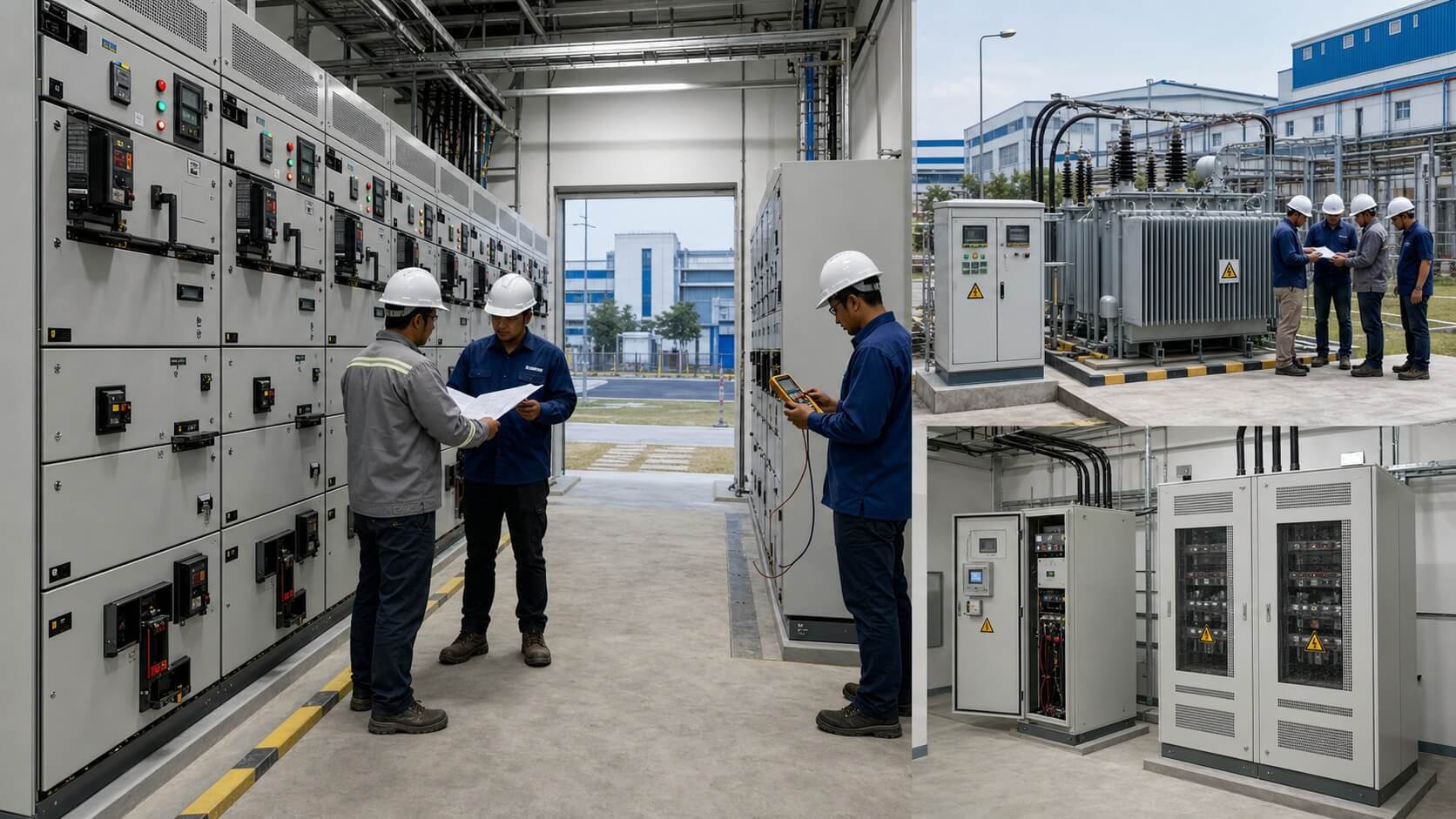
Project overview
Provide 10kV/0.4kV full-voltage power distribution system overall services for the 500-acre first phase of the park, covering the entire process of capacity planning, equipment supply, installation and construction, acceptance and power delivery. It is equipped with an intelligent AMI household metering and energy consumption management system to meet the power needs of settled enterprises in the mechanical processing and electronic manufacturing industries.
Indonesia fit
It provides park owners with a complete procurement path from PLN installation, 10/20kV medium voltage access, 0.4kV distribution, household metering to after-sales spare parts, reducing the time for settled enterprises to repeatedly confirm specifications and interfaces; modular reservation allows different loads such as mechanical processing and electronic manufacturing to be connected in stages, reducing one-time investment and the risk of power outage transformation.
Professional configuration and standards
The medium voltage cabinet is configured according to IEC 62271, the low voltage cabinet is configured according to IEC 61439, the transformer is configured according to IEC 60076, and the key circuit configuration is ACB/MCCB, APFC Reactive power compensation, active filtering and power quality monitoring; the cabinet adopts a withdrawable or fixed partition structure, the busbar is checked according to temperature rise and short-term withstand current, the factory completes the power frequency withstand voltage, mechanical interlocking, secondary circuit, temperature rise and short-circuit withstand capability verification, and the document package supports SNI/PLN acceptance.
Key specification comparison table
| Configuration items | common practice | Optimized delivery specifications and value |
|---|---|---|
| Park access | Single fixed capacity, power outage for later expansion | 10/20kV ring network + 0.4kV zone bus, 30% expansion margin reserved |
| power quality | No compensation or fixed capacitance compensation | APFC+ active filtering, THDi/THDv are controlled according to the requirements of sensitive equipment |
| Measuring by household | The general statement is apportioned, and there are many accounting disputes | AMI household metering + energy consumption report supports independent accounting by tenants |
Delivery challenges and solutions
a.Challenge: Indonesia's National Power Company (PLN) has a long capacity approval cycle, local construction specifications are different from domestic ones, and the risk of delays in project entry is high.
Solution: The localized technical team was dispatched to connect PLN and the local supervision unit 3 months in advance, and started the pre-design at the same time; the withdrawable modular power distribution cabinet was used to adapt to the local construction standards, and the approval and construction cycles were overlapped and compressed.
b.Challenge: The load demands of settled enterprises vary widely, and it is difficult to accurately calculate initial capacity reservations.
Solution: Advance planning reserves 30% capacity expansion margin, and the modular architecture supports later expansion without power outages, matching the phased entry pace of enterprises.
c.Challenge: The park's load fluctuates greatly, and harmonic pollution during peak hours can easily affect precision equipment.
Solution: The standard reactive power compensation + active filter device controls the harmonic distortion rate within 5% to ensure the stable operation of the equipment of the enterprises settled there.
Project results
The project passed PLN acceptance at one time, with power supply reliability reaching 99.9%; electricity bills for public shares are automatically shared, and labor costs for financial reconciliation in the park are reduced by 60%; the second phase expansion can be operated without power outages, shortening the construction period by 70%.