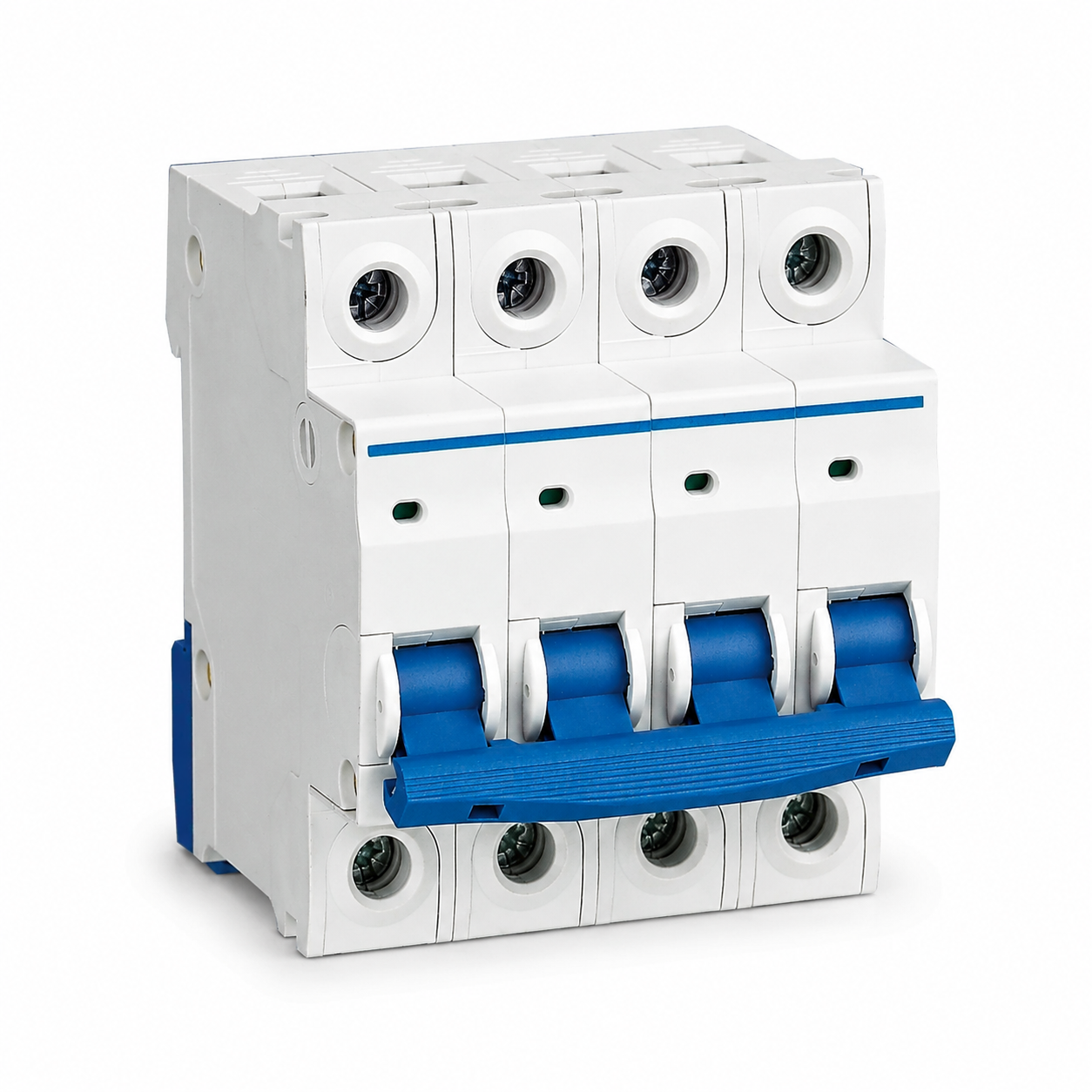
| System parameters | Rated voltage | AC 220V/380V(50Hz), AC 400V(50Hz, 3P, 4P) |
| Rated current | 1A, 2A, 3A, 4A, 6A, 10A, 16A, 20A, 25A, 32A, 40A, 50A, 63A |
| Rated insulation voltage (Ui) | 500V |
| Rated impact resistance Voltage (Uimp) | 6kV |
| Frequency | 50Hz |
| Temperature range | -25℃~+70℃ |
| Number of phases | Three-phase four-wire system |
| Enclosure protection level | IP20 |
| Wiring method | Screw connection |
| Overload protection | No |
| Short circuit protection | Yes |
| Operation method | Manual operation |
| Installation method | Rail installation |
| Weight | 2kg |
| Protection level | IP20 |
| Communication interface | RS485 |
| Performance index | Rated short circuit breaking capacity (Icn) | 1kA, 2.5kA, 4kA, 6kA, 10kA, 20kA, 35kA, 50kA, 65kA |
| Rated ultimate short-circuit breaking capacity (Icu) | 230/400V: 6kA, 440V: 4kA, 690V: 4kA |
| Rated operating short-circuit breaking capacity (Ics) | 230/400V: 4.5kA, 440V: 4kA, 690V: 4kA |
| Shunt release action time | ≤5ms |
| Overload Protection characteristics | Cold state: 1.13In, hot state: 1.45In, cold state: 2.55In, hot state: 4.5In, cold state: 7.2In, hot state: 12In |
| Short circuit protection characteristics | Cold state: 1.13In, hot state: 1.45In, cold state: 2.55In, hot state: 4.5In, cold state: 7.2In, hot state: 12I n |
| Action time | ≤1s |
| Electrical life |
| Mechanical life | ≥10000 times |
| ≥10MΩ |
| Power frequency withstand voltage | 2kV/1min |
| Impact withstand voltage | 6kV |
| Temperature rise | ≤40K |
| Noise | ≤65dB(A) |
| Electromagnetic compatibility | Comply with GB/T 14598.1-2007 standard |
| Anti-interference ability | Comply with GB/T 14598.13-2008 Standard |
| Environmental adaptability | -25℃~+70℃, relative humidity ≤95% (no condensation) |
| Installation environment | Indoor, no severe vibration and impact |
| Usage environment | Dry, well-ventilated indoor environment |
| Storage environment | -25℃~+70℃, relative humidity ≤95% (no condensation) |
| Transportation environment | -40℃~+70℃, relative humidity ≤95% (no condensation) |
| Packaging requirements | Shockproof, moisture-proof, dustproof |
| Marking requirements | Clear, durable and easy to identify |
| Packaging mark | The packaging box should have product name, model, specification, quantity, production date, manufacturer name and address and other information |
| Packaging materials< /td> | Cartons, foam plastics, plastic bags, etc. |
| Packaging method | Needly stacked and firmly fixed |
| Transportation method | Cars, trains, ships, airplanes, etc. |
| Storage requirements | Stored in a dry, ventilated, non-corrosive gas warehouse |
| Inspection requirements | Factory inspection, type inspection, routine inspection, etc. |
| Inspection items | Appearance inspection, functional test, performance test, etc. |
| < /td> | Inspection methods | Visual inspection, instrument measurement, simulation test, etc. |
| Inspection standards | Conform to relevant national standards and industry standards |
| Inspection records | Record the inspection results in detail, including qualified and unqualified conditions |
| Inspection report | Issue an inspection report, indicating the inspection results and conclusions< /td> |
| Inspection cycle | Carry out regularly, the specific cycle is determined according to product characteristics and usage environment |
| Inspection personnel | Have Correspondingly qualified professional and technical personnel |
| Inspection equipment | Precision instruments and special equipment |
| Inspection environment | Comply with inspection Laboratory or workshop required for inspection |
| Processing of inspection results | Rework or scrap unqualified products to ensure product quality |
| Inspection records Record preservation | Inspection records should be kept for a long time for review and traceability |
| Inspection report archiving | Inspection reports should be archived and managed to facilitate inquiry and review |
| Feedback on inspection results | Feedback the inspection results to relevant departments and personnel in a timely manner for improvement and optimization |
| Analysis of inspection results | Statistics on the inspection results Analyze, find out the root cause of the problem, and take measures to improve |
| Application of inspection results | Apply inspection results to product design, production and quality management to improve product quality and reliability |
| Evaluation of inspection results | Evaluate the inspection results objectively to ensure the fairness and scientificity of the inspection work |
| Supervision of inspection results | Supervision of the inspection process Supervise the inspection results to ensure the standardization and effectiveness of the inspection work |
| Inspection result certification | Certify the inspection results to ensure that the quality and safety of the product comply with relevant standards and requirements |
| Disclosure of inspection results | Publish the inspection results within an appropriate scope and accept social supervision and evaluation |
| Trace inspection results | Establish inspection results Fruit traceability mechanism to ensure traceability of product quality and safety |
| Improvement of inspection results | Propose improvement suggestions based on inspection results to continuously improve product quality and management levels |
| Inspection results training | Train relevant personnel on inspection knowledge and skills to improve the level of inspection work |
| Exchange inspection results | Strengthen communication with peers and customers exchange, share inspection experience and results, and jointly improve product quality |
| Innovation in inspection results | Continuously explore new inspection methods and technologies to improve the efficiency and accuracy of inspection work |
| Cooperation on inspection results | Cooperate with scientific research institutions and universities to carry out research and development of inspection technology and promote industry development |
| Inspection results are in line with international standards | Actively participate in international standardization activities and promote the international development of inspection technology |
| Social Responsibility for Inspection Results | Perform social responsibilities, ensure product quality and safety, and protect consumer rights |
| Inspection results Environmental protection | Pay attention to environmental protection, use environmentally friendly materials and processes to reduce the impact on the environment |
| Inspection results Sustainable development |
| Economic benefits of inspection results | Improve the economic benefits of inspection work, reduce production costs, and improve corporate competitiveness |
| Social benefits of inspection results | Improve the social benefits of inspection work and promote social harmony and progress |
| Cultural inheritance of inspection results | Carry forward inspection culture, inherit fine traditions, and cultivate professional talents |
| Inspection results brand building | Strengthen brand building and enhance corporate image and market influence |
| Innovation-driven inspection results | Strengthen innovation-driven and promote innovative development of inspection technology |
| Improving the quality of inspection results | Continue to improve the quality of inspection work and ensure product quality High quality and high reliability |
| Improved efficiency of inspection results | Continuously improve the efficiency of inspection work, shorten inspection cycles, and improve production efficiency |
| Inspection result cost control | Effectively control inspection costs, reduce enterprise operating costs, and improve economic benefits |
| Inspection result risk management | Strengthen risk management, prevent and control the inspection process Possible risks |
| Compliance management of inspection results | Ensure that the inspection work complies with relevant laws, regulations and standards and avoid legal risks |